955 stories
·
0 followers

EPA To Stop Considering Lives Saved By Limiting Air Pollution

1 Share
An anonymous reader quotes a report from the New York Times: For decades, the Environmental Protection Agency has calculated the health benefits of reducing air pollution, using the cost estimates of avoided asthma attacks and premature deaths to justify clean-air rules. Not anymore. Under President Trump, the E.P.A. plans to stop tallying gains from the health benefits caused by curbing two of the most widespread deadly air pollutants, fine particulate matter and ozone, when regulating industry, according to internal agency emails and documents reviewed by The New York Times. It's a seismic shift that runs counter to the E.P.A.'s mission statement, which says the agency's core responsibility is to protect human health and the environment, environmental law experts said. The change could make it easier to repeal limits on these pollutants from coal-burning power plants, oil refineries, steel mills and other industrial facilities across the country, the emails and documents show. That would most likely lower costs for companies while resulting in dirtier air. "The idea that E.P.A. would not consider the public health benefits of its regulations is anathema to the very mission of E.P.A.," said Richard Revesz, the faculty director of the Institute for Policy Integrity at New York University School of Law. "If you're only considering the costs to industry and you're ignoring the benefits, then you can't justify any regulations that protect public health, which is the very reason that E.P.A. was set up."

Read more of this story at Slashdot.

Read the whole story
Share this story
Delete

Judge: Trump violated Fifth Amendment by ending energy grants in only blue states

1 Share

The Trump administration violated the Fifth Amendment when canceling billions of dollars in environmental grants for projects in "blue states" that didn't vote for him in the last election, a judge ruled Monday.

Trump's blatant discrimination came on the same day as the government shut down last fall. In total, 315 grants were terminated in October, ending support for 223 projects worth approximately $7.5 billion, the Department of Energy confirmed. All the awardees, except for one, were based in states where Donald Trump lost the majority vote to Kamala Harris in 2024.

Only seven awardees sued, defending projects that helped states with "electric vehicle development, updating building energy codes, and addressing methane emissions." They accused Trump officials of clearly discriminating against Democratic voters by pointing to their social media posts boasting about punishing blue states.

On X, the director of the Office of Management and Budget, Russell Vought, bragged that nearly "$8 billion in Green NewScam funding to fuel the Left’s climate agenda is being cancelled," then listed only states that did not vote for Trump. Meanwhile on Truth Social, Trump confirmed he met with Vought to "determine which of the many Democrat Agencies, most of which are a political SCAM, he recommends to be cut" during the shutdown.

On Monday, US District Judge Amit Mehta wrote in his opinion that the case was "unique" because ordinarily "the mere presence of political considerations in an agency action" does not mean that officials have run "afoul of the Fifth Amendment’s guarantee of equal protection."

But in this case, Trump "freely" admitted that he made grant termination decisions "primarily—if not exclusively—based on whether the awardee resided in a state whose citizens voted for President Trump in 2024." And that classification had "no rational relationship" to the government's supposed interest in cutting off funding, Mehta found, which was that projects were not "economically viable" or didn't advance the administration's energy goals.

In fact, Mehta noted that similar projects in red states continued to receive funding.

"There is no reason to believe that terminating an award to a recipient located in a state whose citizens tend to vote for Democratic candidates—and, particularly, voted against President Trump—furthers the agency’s energy priorities any more than terminating a similar grant of a recipient in a state whose citizens tend to vote for Republican candidates or voted for President Trump," Mehta said.

Trump officials offered "no explanation for how their purposeful segregation of grantees based on their electoral support for President Trump rationally advances their stated government interest," Mehta said. Instead, "defendants concede that the political identity of a terminated grantee’s state, including the fact that the state supported Vice President Kamala Harris in the 2024 election, played a preponderant role in the October 2025 grant termination decisions."

It wasn’t a total win for plaintiffs, who did not prevail on First Amendment claims, and there are many hundreds of awardees whose grant terminations were so far not impacted by the narrow ruling.

Deciding that the government had violated grantees' rights to equal protection, Mehta only ordered a return to the status quo, reinstating seven grants totaling $27.6 million.

Read full article

Comments


Read the whole story
Share this story
Delete

Cory Doctorow: Legalising Reverse Engineering Could End 'Enshittification'

2 Shares
Scifi author/tech activist Cory Doctorow has decried the "enshittification" of our technologies to extract more profit. But Saturday he also described what could be "the beginning of the end for enshittification" in a new article for the Guardian — "our chance to make tech good again". There is only one reason the world isn't bursting with wildly profitable products and projects that disenshittify the US's defective products: its (former) trading partners were bullied into passing an "anti-circumvention" law that bans the kind of reverse-engineering that is the necessary prelude to modifying an existing product to make it work better for its users (at the expense of its manufacturer)... Post-Brexit, the UK is uniquely able to seize this moment. Unlike our European cousins, we needn't wait for the copyright directive to be repealed before we can strike article 6 off our own law books and thereby salvage something good out of Brexit... Until we repeal the anti-circumvention law, we can't reverse-engineer the US's cloud software, whether it's a database, a word processor or a tractor, in order to swap out proprietary, American code for robust, open, auditable alternatives that will safeguard our digital sovereignty. The same goes for any technology tethered to servers operated by any government that might have interests adverse to ours — say, the solar inverters and batteries we buy from China. This is the state of play at the dawn of 2026. The digital rights movement has two powerful potential coalition partners in the fight to reclaim the right of people to change how their devices work, to claw back privacy and a fair deal from tech: investors and national security hawks. Admittedly, the door is only open a crack, but it's been locked tight since the turn of the century. When it comes to a better technology future, "open a crack" is the most exciting proposition I've heard in decades. Thanks to Slashdot reader Bruce66423 for sharing the article.

Read more of this story at Slashdot.

Read the whole story
Share this story
Delete

Conservative lawmakers want porn taxes. Critics say they’re unconstitutional.

1 Share

As age-verification laws continue to dismantle the adult industry—and determine the future of free speech on the internet—a Utah lawmaker proposed a bill this week that would enforce a tax on porn sites that operate within the state.

Introduced by state senator Calvin Musselman, a Republican, the bill would impose a 7 percent tax on total receipts “from sales, distributions, memberships, subscriptions, performances, and content amounting to material harmful to minors that is produced, sold, filmed, generated, or otherwise based” in Utah. If passed, the bill would go into effect in May and would also require adult sites to pay a $500 annual fee to the State Tax Commission. Per the legislation, the money made from the tax will be used by Utah’s Department of Health and Human Services to provide more mental health support for teens.

Musselman did not respond to a request for comment.

A new age of American conservatism commands the political arena, and more US lawmakers are calling for additional restrictions on adult content. In September, Alabama became the first state to impose a porn tax on adult entertainment companies (10 percent) following the passage of age-verification mandates, which require users to upload an ID or other personal documentation to verify that they are not a minor before viewing sexually explicit content. Pennsylvania lawmakers are also eyeing a bill that would tax consumers an additional 10 percent on “subscriptions to and one-time purchases from online adult content platforms,” despite already requiring them to pay a 6 percent sales and use tax for the purchase of digital products, two state senators wrote in a memo in October. Other states have flirted with the idea of a porn tax in the past. In 2019, Arizona state senator Gail Griffin, a Republican, proposed taxing adult content distributors to help fund the border wall, a key priority during Donald Trump’s first presidential term. So far, 25 US states have passed a form of age verification.

Although efforts to criminalize participants in the sex work industry have been ongoing for years—with new regulations unfolding at a moment of heightened online surveillance and censorship—targeted taxes have failed to gain widespread approval because the legality of such laws is up for debate.

“This kind of porn tax is blatantly unconstitutional,” says Evelyn Douek, an associate professor of law at Stanford Law School. “It singles out a particular type of protected speech for disfavored treatment, purely because the legislature doesn’t like it—that’s exactly what the First Amendment is designed to protect against. Utah may not like porn, but as the Supreme Court affirmed only last year, adults have a fully protected right to access it.”

Utah, Alabama, and Pennsylvania are among the 16 states that have adopted resolutions declaring porn a public health crisis. “We realize this is a bold assertion not everyone will agree on, but it’s the full-fledged truth,” Utah governor Gary Herbert tweeted in 2016 after signing the resolution. One of Utah’s earliest statewide responses to the proliferation of adult content happened in 2001, when it became the first state to create an office for sexually explicit issues by hiring an obscenity and pornography complaints ombudsman. The position—dubbed the “porn czar”—was terminated in 2017.

“Age restriction is a very complex subject that brings with it data privacy concerns and the potential for uneven and inconsistent application for different digital platforms,” Alex Kekesi, vice president of brand and community at Pornhub, told WIRED in a previous conversation. In November, the company urged Google, Microsoft, and Apple to enact device-based verification in their app stores and across their operating systems. “We have seen several states and countries try to impose platform-level age verification requirements, and they have all failed to adequately protect children.” To comply with the new age gate mandates, Pornhub has currently blocked access to users in 23 states.

Critics argue that age verification has never been about protecting children but rather scrubbing porn from the internet. A video leaked in 2024 by the Centre for Climate Reporting showed Russell Vought, a Trump ally and Project 2025 coauthor, calling age verification laws a “back door” tactic to a federal porn ban.

Sites like OnlyFans and Pornhub have brought platform-dependent sex work into the mainstream, but they have also made it easier to police adult entertainers and consumers. As more states begin to implement added tariffs on sex work, creators will bear the brunt of the new laws more than anyone.

The skewed ideology of cultural conservatism that is taking shape under Trump 2.0 wants to punish sexual expression, says Mike Stabile, director of public policy at the Free Speech Coalition, a trade association for the adult industry in the US. “When we talk about free speech, we generally mean the freedom to speak, the ability to speak freely without government interference. But in this case, free also means not having to pay for the right to do so. A government tax on speech limits that right to those who can afford it.”

According to company policy, OnlyFans complies with all tax requirements in the jurisdictions in which it operates. Creators are responsible for their own tax affairs. Pornhub, which is currently blocked in Utah and Alabama, did not respond to a request for comment.

Douek notes that following the Supreme Court’s decision to uphold age-verification laws in Texas, states can legally regulate minors’ access to sexually explicit material, “but a porn tax does nothing to limit minors’ access to this speech—it simply makes it more expensive to provide this content to adults.” A 2022 report from Common Sense Media, a youth advocacy nonprofit, found that 73 percent of teens age 13 to 17 have watched adult content online. Today, young people regularly access NSFW content via social media, on platforms like X and Snap. Last year, a survey by the UK’s Office of the Children’s Commissioner reported that 59 percent of minors are being exposed to porn by accident, primarily via social media, up from 38 percent in 2023.

In Alabama, as would be the case with Utah, revenue raised by the tax is being used for behavioral health services, including prevention, treatment, and recovery support for young people.

Alabama state representative Ben Robbins, the bill’s Republican sponsor, said in an interview last year that adult content was “a driver in causing mental health issues” in the state. It’s a common argument among lawmakers pushing for a nationwide porn ban. Some scientific studies suggest that adolescent exposure to porn increases rates of depression, low self-esteem, and normalized violence, but health professionals have never reached a consensus on the matter.

With lawmakers working to reframe the issue around underage harm, Stabile says it’s critical to remember that adult content isn’t different from any other kind of protected speech, noting that content-specific taxes on speech have repeatedly been struck down by the courts as unconstitutional censorship.

“What if a state decided that Covid misinformation was straining state health resources and taxed newsletters who promoted it? What if the federal government decided to require a costly license to start a podcast? What if a state decided to tax a certain newspaper it didn't like?” he says. “Porn isn’t some magical category of speech separate from movies, streaming services, or other forms of entertainment. Adult businesses already pay taxes on the income they earn, just as every other business does. Taxing them because of imagined harms is not only dangerous to our industry, it sets a dangerous precedent for government power.”

This story originally appeared on WIRED.com

Read full article

Comments


Read the whole story
Share this story
Delete

“Ungentrified” Craigslist may be the last real place on the Internet

1 Share

The writer and comedian Megan Koester got her first writing job, reviewing Internet pornography, from a Craigslist ad she responded to more than 15 years ago. Several years after that, she used the listings website to find the rent-controlled apartment where she still lives today. When she wanted to buy property, she scrolled through Craigslist and found a parcel of land in the Mojave Desert. She built a dwelling on it (never mind that she’d later discover it was unpermitted) and furnished it entirely with finds from Craigslist’s free section, right down to the laminate flooring, which had previously been used by a production company.

“There’s so many elements of my life that are suffused with Craigslist,” says Koester, 42, whose Instagram account is dedicated, at least in part, to cataloging screenshots of what she has dubbed “harrowing images” from the site’s free section; on the day we speak, she’s wearing a cashmere sweater that cost her nothing, besides the faith it took to respond to an ad with no pictures. “I’m ride or die.”

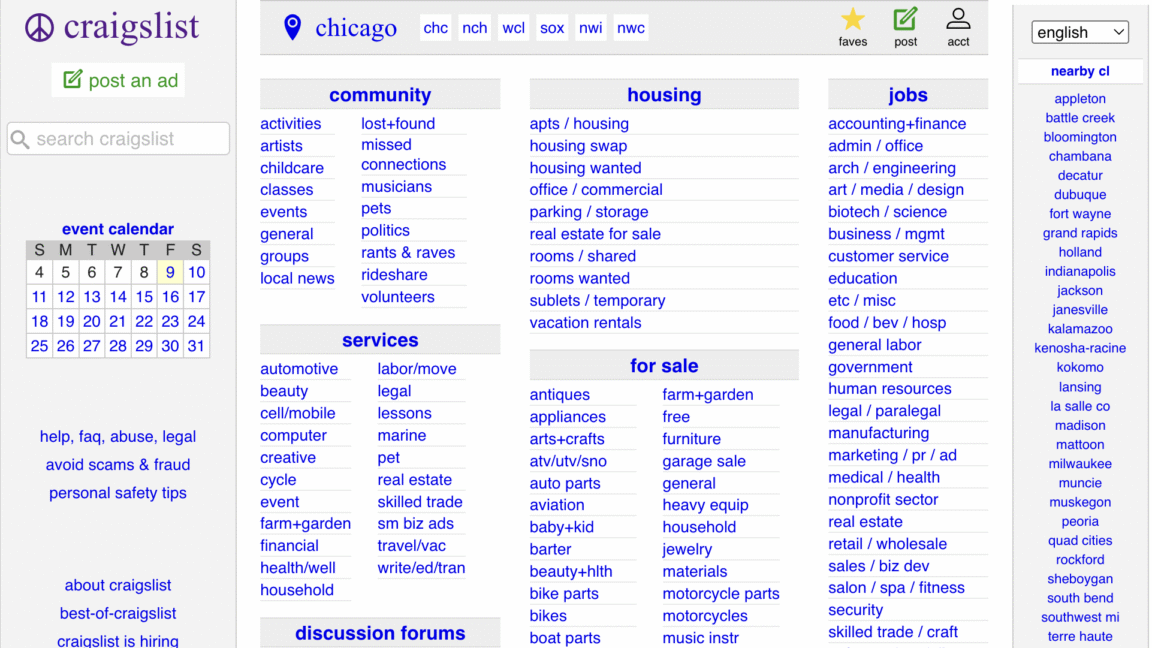
Koester is one of untold numbers of Craigslist aficionados, many of them in their thirties and forties, who not only still use the old-school classifieds site but also consider it an essential, if anachronistic, part of their everyday lives. It’s a place where anonymity is still possible, where money doesn’t have to be exchanged, and where strangers can make meaningful connections—for romantic pursuits, straightforward transactions, and even to cast unusual creative projects, including experimental TV shows like The Rehearsal on HBO and Amazon Freevee’s Jury Duty. Unlike flashier online marketplaces such as DePop and its parent company, Etsy, or Facebook Marketplace, Craigslist doesn’t use algorithms to track users’ moves and predict what they want to see next. It doesn’t offer public profiles, rating systems, or “likes” and “shares” to dole out like social currency; as a result, Craigslist effectively disincentivizes clout-chasing and virality-seeking—behaviors that are often rewarded on platforms like TikTok, Instagram, and X. It’s a utopian vision of a much earlier, far more earnest Internet.

“The real freaks come out on Craigslist,” says Koester. “There's a purity to it.” Even still, the site is a little tamer than it used to be: Craigslist shut down its “casual encounters” ads and took its personals section offline in 2018, after Congress passed legislation that would’ve put the company on the hook for listings from potential sex traffickers. The “missed connections” section, however, remains active.

The site is what Jessa Lingel, an associate professor of communication at the University of Pennsylvania, has called the “ungentrified” Internet. If that’s the case, then online gentrification has only accelerated in recent years, thanks in part to the proliferation of AI. Even Wikipedia and Reddit, visually basic sites created in the early aughts and with an emphasis similar to Craigslist’s on fostering communities, have both incorporated their own versions of AI tools.

Some might argue that Craigslist, by contrast, is outdated; an article published in this magazine more than 15 years ago called it “underdeveloped” and “unpredictable.” But to the site’s most devoted adherents, that’s precisely its appeal.

“ I think Craigslist is having a revival,” says Kat Toledo, an actor and comedian who regularly uses the site to hire cohosts for her LA-based stand-up show, Besitos. “When something is structured so simply and really does serve the community, and it doesn't ask for much? That’s what survives.”

Toledo started using Craigslist in the 2000s and never stopped. Over the years, she has turned to the site to find romance, housing, and even her current job as an assistant to a forensic psychologist. She’s worked there full-time for nearly two years, defying Craigslist’s reputation as a supplier of potentially sketchy one-off gigs. The stigma of the website, sometimes synonymous with scammers and, in more than one instance, murderers, can be hard to shake. “If I'm not doing a good job,” Toledo says she jokes to her employer, “just remember you found me on Craigslist.”

But for Toledo, the site’s “random factor”—the way it facilitates connection with all kinds of people she might not otherwise interact with—is also what makes it so exciting. Respondents to her ads seeking paid cohosts tend to be “people who almost have nothing to lose, but in a good way, and everything to gain,” she says. There was the born-again Christian who performed a reenactment of her religious awakening and the poet who insisted on doing Toledo’s makeup; others, like the commercial actor who started crying on the phone beforehand, never made it to the stage.

It’s difficult to quantify just how many people actively use Craigslist and how often they click through its listings. The for-profit company is privately owned and doesn’t share data about its users. (Craigslist also didn’t respond to a request for comment.) But according to the Internet data company similarweb, Craigslist draws more than 105 million monthly users, making it the 40th most popular website in the United States—not too shabby for a company that doesn’t spend any money on advertising or marketing. And though Craigslist’s revenue has reportedly plummeted over the past half-dozen years, based on an estimate from an industry analytics firm, it remains enormously profitable. (The company generates revenue by charging a modest fee to publish ads for gigs, certain types of goods, and in some cities, apartments.)

“It’s not a perfect platform by any means, but it does show that you can make a lot of money through an online endeavor that just treats users like they have some autonomy and grants everybody a degree of privacy,” says Lingel. A longtime Craigslist user, she began researching the site after wondering, “Why do all these web 2.0 companies insist that the only way for them to succeed and make money is off the back of user data? There must be other examples out there.”

In her book, Lingel traces the history of the site, which began in 1995 as an email list for a couple hundred San Francisco Bay Area locals to share events, tech news, and job openings. By the end of the decade, engineer Craig Newmark’s humble experiment had evolved into a full-fledged company with an office, a domain name, and a handful of hires. In true Craigslist fashion, Newmark even recruited the company’s CEO, Jim Buckmaster, from an ad he posted to the site, initially seeking a programmer.

The two have gone to great lengths to wrest the company away from corporate interests. When they suspected a looming takeover attempt from eBay, which had purchased a minority stake in Craigslist from a former employee in 2004, Newmark and Buckmaster spent roughly a decade battling the tech behemoth in court. The litigation ended in 2015, with Craigslist buying back its shares and regaining control.

“ They are in lockstep about their early ’90s Internet values,” says Lingel, who credits Newmark and Buckmaster with Craigslist’s long-held aesthetic and ethos: simplicity, privacy, and accessibility. “As long as they're the major shareholders, that will stay that way.”

Craigslist’s refusal to “sell out,” as Koester puts it, is all the more reason to use it. “Not only is there a purity to the fan base or the user base, there’s a purity to the leadership that they’re uncorruptible basically,” says Koester. “I’m gonna keep looking at Craigslist until I die.” She pauses, then shudders: “Or, until Craig dies, I guess.”

This story originally appeared on wired.com.

Read full article

Comments


Read the whole story
Share this story
Delete

RFK Jr.’s dietary guidelines: Beef tallow is in, but no booze for breakfast

1 Share

Anti-vaccine Health Secretary Robert F. Kennedy Jr. and Agriculture Secretary Brook Rollins unveiled the delayed 2025–2030 Dietary Guidelines for America Wednesday, which is already drawing criticism for its ties to the meat and dairy industry.

Headlining with the advice to "eat real food," the new guidelines, which are updated every five years, are in a brisk, citation-free 10-page document. Overall, the new guidelines: lambaste added sugars and highly processed foods (though it doesn't clearly define them); ditch previous limits on alcohol while directing Americans to just drink "less"; beef up recommendations for protein, including red meat; and appear to embrace saturated fats while not actually changing the 2020–2025 recommendation for how much you should eat—which was and continues to be no more than 10 percent of total daily calories.

"We are ending the war on saturated fats," Kennedy said triumphantly in a White House press briefing Wednesday, despite the lack of a change. He went on to proclaim that "today, our government declares war on added sugar," though that too is questionable.

This is war?

While the new guidelines say "no amount of added sugars or non-nutritive sweeteners is recommended," it offers the suggestion that "one meal should contain no more than 10 grams of added sugars." There are four calories in one gram of sugar, so the recommendation means no more than 40 calories from sugar per meal. For three meals a day, that's a max of 120 calories from sugar a day, which on a 2,000-calorie-a-day diet, would be about 6 percent of total calories. The previous recommendation in the 2020–2025 guidelines was to have less than 10 percent of total calories per day from added sugars.

Earning some praise from outside experts, including the American Medical Association, the new guidelines are the first iteration to directly address highly processed foods. While emphasizing "whole, nutrient-dense foods," it aims for a "dramatic reduction in highly processed foods laden with refined carbohydrates, added sugars, excess sodium, unhealthy fats, and chemical additives."

While the guidelines don't provide a clear definition of what constitutes highly processed foods or how consumers can identify them, they do offer some broad examples at various points, including store-bought "chips, cookies, and candy," and "white bread, ready-to-eat or packaged breakfast options, flour tortillas, and crackers."

New triangle

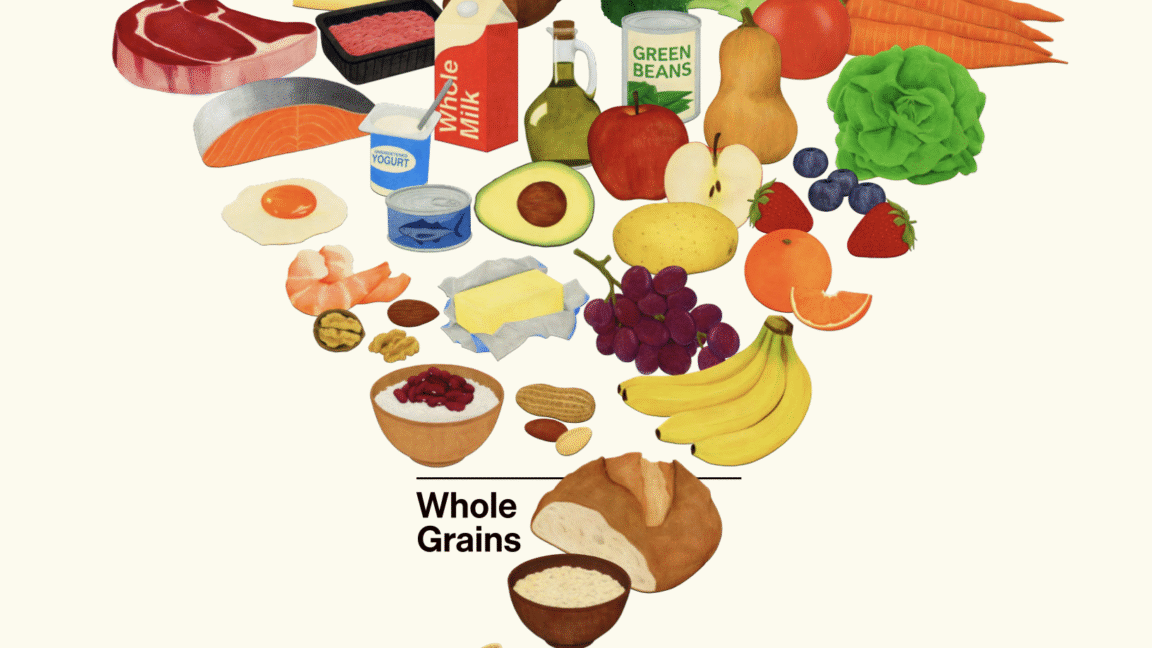
In an effort to steer Americans to healthy choices, the new guidance unveils a new(ish) visual aid—a food pyramid that is upside-down, thus resembling a funnel.

The move at least explains a puzzling trend: Over the past year, Kennedy and other Trump administration officials have repeatedly made reference to the food pyramid—though only to mock and scorn it, often with inaccuracies.

“The dietary guidelines that we inherited from the Biden administration were 453 pages long," Kennedy said in August, referring to the 2020–2025 guidelines, which are 164 pages long. "They were driven by the same commercial impulses that put Froot Loops at the top of the food pyramid."

On Wednesday's unveiling of the new guidelines, Food and Drug Administration Commissioner Marty Makary lamented that, "for decades, we've been fed a corrupt food pyramid."

Not only were Froot Loops never listed on a food pyramid, no food pyramid has been included in federal dietary guidelines for over a decade, raising the question of why the administration was repeatedly attacking a defunct polyhedron. The original food pyramid was introduced in 1992, significantly revised in 2005, and ditched entirely in 2011. Since then, the guidelines have used MyPlate as a visual aid, intended to provide a simplistic depiction of the foods people should eat, in their recommended proportions, on a plate.

Inconsistent imagery

The resurrection of a pyramid in its upside-down form clarifies the administration's geometric obsession. In the new funnel version, though, the food groups are a jumbled spectrum, rather than stacked or divided, leaving proportions up to guesswork. The wide top of the funnel includes a large slab of red meat, a wedge of cheese, a whole roasted bird, broccoli, carrots, and a bag of frozen peas. As it tapers downward, it includes whole milk and unsweetened yogurt, "healthy fats" including olive oil and a stick of butter, as well as fruits and nuts, and then ends with whole grains.

(The written guidance identifies "healthy fats" as olive oil, but also "butter or beef tallow." Beef tallow is a fat Kennedy has personally endorsed, but is probably harder to easily depict in a drawing.)

The visual guidance seems to create some conflict with the guidelines' written recommendation to limit saturated fat to 10 percent of total calories, given that red meat and whole-fat dairy contain high amounts of saturated fat.

In a response, the American Heart Association said it was "concerned" about the guidelines, noting that saturated fats, along with salt, are the "primary drivers of cardiovascular disease." The guidance also suggests that people can eat more than the recommended 2,300 mg limit of sodium a day if they work out to, they said, "offset sweat losses" (no citation included).

Pending scientific evidence suggesting otherwise, the AHA's stance is for people to reduce sugar and sodium and to "prioritize plant-based proteins, seafood and lean meats and to limit high-fat animal products including red meat, butter, lard and tallow, which are linked to increased cardiovascular risk."

Boozy breakfast?

Another change in the guidelines that is conspicuously missing scientific backing is a rollback of recommendations to limit alcohol. Gone from the federal guidance is the previous hard limit of no more than two drinks a day for men and one drink a day for women. Instead, the guidance encourages Americans to simply drink "less."

When a reporter asked about this in the press briefing Wednesday, Dr. Mehmet Oz, administrator of the Centers for Medicare & Medicaid Services, responded, saying, "alcohol is a social lubricant that brings people together."

"In the best-case scenario, I don't think you should drink alcohol, but it does allow people an excuse to bond and socialize," Oz said. "And there's probably nothing healthier than having a good time with friends in a safe way." While he emphasized small amounts, he went on to note that in "blue zones," areas where people seem to live long lives, alcohol is part of diets.

"So, there is alcohol on these dietary guidelines, but the implication is don't have it for breakfast."

Conflicts of interest

While the guidelines seem favorable for the alcohol industry, overall, the meat and dairy industry are the clear winners, topping the funnel. Documents released alongside the dietary guidelines identify nine experts who helped craft the final document. Of the nine, at least four have had ties to the meat and dairy industry in the past three years. Those include the National Cattleman's Beef Association, the National Pork Board, the National Dairy Council, and the California Dairy Research Foundation. Two also had links to General Mills, and one was linked to pharmaceutical giant Novo Nordisk, maker of weight-loss drug Wegovy among many other medications. The clear conflicts of interest have already drawn criticism from outside nutrition experts.

Read full article

Comments


Read the whole story
Share this story
Delete
Next Page of Stories